Archives: Poets

Horace
65BCE - 8BCE
Horace, with Virgil, is one of the twin giants of poetry in the time of Augustus. While Virgil was taking the Greek tradition of epic poetry and giving it a new set of completely Roman clothes with the Aeneid, Horace was taking the Greek tradition of lyric poetry that was the established stock-in-trade for much non-epic Roman poetry, and giving it a new and distinctly Roman character.
Odes, 1.1
Horace’s first Ode
Maecenas atavis edite regibus
Horace dedicates his first Ode to his patron, Maecenas
Odes 1.2
Rome: disaster and salvation
Iam satis terris nivis atque dirae
Horace exalts Augustus, the saviour of Rome from civil war
Odes 1.3
Virgil’s perils on the sea
Sic te diva potens Cypri
Horace prays for a safe voyage for Virgil
Odes Book 1.4
Carpe diem, Sestius
Solvitur acris hiems grata vice veris et Favoni
The joys of spring are short, Sestius
Odes 1.7
The consolations of wine
Laudabunt alii claram Rhodon aut Mytilenen
Pride of place and the pleasure of wine
Odes 1.9
Soracte
Vides ut alta stet nive candidum Soracte
Life is short – enjoy it while you are young
Odes 1.11
Gathering rosebuds: carpe diem
Tu ne quaesieris (scire nefas) quem mihi, quem tibi
Carpe diem
Odes 1.12
Augustus, master of the world
Quem virum aut heroa lyra vel acri
Horace sets out to praise, and does not hold back
Odes 1.15
Nereus prophesies the Trojan War
Pastor cum traheret per freta navibus
An epic theme in lyric verse
Odes 1.17
The country is best
Velox amoenum saepe Lucretilem
Horace prefers his Sabine farm to town life
Odes 1.18
The pleasures and dangers of wine
Odes 1.21
Diana and Apollo: a hymn
Dianam tenerae dicite virgines
A chorus of boys and girls hymns Diana and Apollo
Horace Odes, Book 1.22
Horace, the wolf and the upright life
Integer vitae scelerisque purus
The upright life protects Horace from a wolf
Odes 1.24
Mourning for a good man
Quis desiderio sit pudor aut modus
Quintilius, a good man and a friend of Virgil, has died
Odes 1.26
A garland from the Muses
Musis amicus tristitiam et metus
A garland from the Muses - and Horace
Odes 1.28
A plea for burial
Te maris et terrae numeroque carentis harenae
An earthbound spirit speaks
Odes 1.30
A prayer to Venus
Odes 1.34
A change of mind
Parcus deorum cultor et infrequens
Thunder from a clear sky shakes Horace's convictions
Odes, 1.36
Numida’s back
Ode 2.1
Pollio’s histories of civil war
Motum ex Metello consule civicum
A statesman and historian writes on the civil wars
Odes 2.2
Wealth should be used, not hoarded
Nullus argento color est avaris
Money should be put to use
Odes 2.4
Love a slave-girl? Oh, Xanthias!
Ne sit ancillae tibi amor pudori
Of course it's OK to fall in love with a slave(!)
Odes 2.6
Tibur or Tarentum: a poet’s dilemma?
Septimi, Gadis aditure mecum
Tibur or Tarentum: a poet's dilemma?
Odes 2.7
Horace welcomes his army comrade
O saepe mecum tempus in ultimum
Horace welcomes his army comrade
Odes Book 2. 19
Horace’s reverence to Bacchus
Bacchum in remotis carmina rupibus
Horace's hymn to Bacchus
Odes 3.2
What Roman youth should be
Angustam amice pauperium pati
Dulce et decorum est pro patria mori
Odes 3.5
Courage and decadence: the Regulus ode
Caelo tonantem credidimus Iovem regnare
Horace's Regulus ode
Odes 3.8
An invitation to Maecenas
Martiis caelebs quid agam kalendis
A fulsome compliment to Horace's patron Maecenas
Odes 3.20
The tug-of-war for Nearchus
Non vides quanto moveas periclo
Pyrrhus has a fight on his hands for Nearchus.
Odes 3.28
Celebrating Neptune’s feast day
Festo quid potius die festo Neptuni faciam?
Horace celebrates Neptune's feast day
Odes 3.30
Horace’s monument
Exegi monumentum aere perennius
Horace concludes the Odes - or so he thinks
Odes 4.2
Pindar and Augustus
Odes 4.7
Housman and Horace
Gratia cum Nymphis geminisque sororibus audet
The snows are fled away, leaves on the shaws
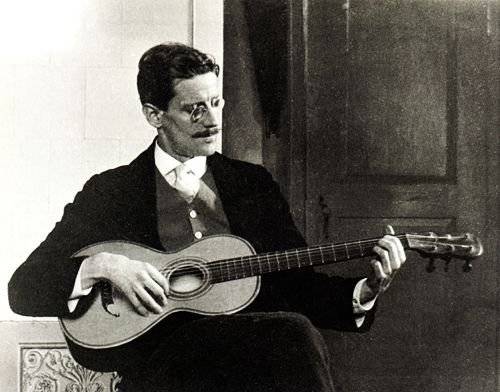
James Joyce
1882 - 1941
The character based on Joyce himself in his books is surnamed Dedalus, after the mythical master artist and maker of labyrinths: Joyce was both.
From "Pomes, Pennyeach"
Tilly
He travels after a winter sun
Joyce's feelings on the death of his mother

Lucan
3 - 30 CE
Author of "De Bello Civile" ("On the Civil War"), also known as the Pharsalia.
De Bello Civile Book 1, lines 125 - 157
Pompey the oak and Caesar the thunderbolt
Quis iustius induit arma
Lucan introduces the combatants at the beginning of his poem on the civil war
De Bello Civile Book 1, lines 213 - 234
Caesar crosses the Rubicon
Fonte cadit modico, parvisque impellitur undis
Caesar crosses the Rubicon
De Bello Civile Book 1, lines 356 - 391
Caesar’s Centurion pledges loyalty
Summi tunc munera pili
Lessons in loyalty and daring from an old campaigner

Lucretius
c. 99 - c. 55 BCE
Lucretius wrote De Rerum Natura, a work exploring cosmology, physics and theology in order to explain and justify the philosophical basis for Epicureanism.
De Rerum Natura, lines 1.44 - 1.48 and 3.894 - 911
Lucretius’s consolation
omnis enim per se divum natura necessest
Lucretius offers the rational view of grief and fear

Marcel Proust
1871 - 1922
From “À la Recherche du Temps Perdu”
Saint-Loup of the Brazen Helm
M. Bloch souffrait beaucoup des mensonges de son oncle
Young Bloch and his Homeric turn of phrase

Milton
1608 - 1674
England's great 17th-century epic poet.
Paradise Lost Book 1, lines 1 - 26
Paradise Lost begins
Of Man's first disobedience, and the fruit
The opening lines of Milton's great epic

Ovid
43BC - c.18CE
Ovid built a glittering career as the fashionable poet of Love and mythology, but made an enemy of the Emperor Augustus and died around 18 CE after a long and unhappy exile. Meet him at Pantheon Poets.
Ovid Amores Book 2. 12
Ovid’s triumph
Ite triumphales circum mea tempora laurus
Ovid congratulates himself on success with Corinna
Amores, Book 3.14
Ovid’s broad-minded advice to his mistress
Sit tibi mens melior
Kiss, but don't tell!
Metamorphoses Book 1, lines 466-76 and 525-67
Apollo and Daphne
inpiger umbrosa Parnasi constitit arce
To escape Apollo, Daphne becomes a laurel tree
Metamorphoses Book 2, lines 150 - 177
Phaethon
Occupat ille levem juvenali corpore currum
Phaethon's ride in the chariot of the Sun begins.
Metamorphoses Book 2, lines 178 - 216
Phaethon, continued
Ut vero summo despexit ab aethere terras
Phaethon's disastrous ride in the chariot of the Sun continues
Metamorphoses Book 2, lines 301 - 332
Phaethon, concluded
Dixerat haec Telllus: neque enim tolerare vaporem
Jupiter's intervention finally brings Phaethon's disastrous chariot-ride to a close
Metamorphoses Book 2, lines 843 - 875
Europa and the bull
dixit, et expulsi iamdudum monte iuvenci
The story of Europa
Metamorphoses book 4, lines 169-189
Venus and Mars
Hunc quoque, siderea qui temperat omnia luce
Adultery in heaven
Ovid Metamorphoses Book 4, lines 449-56; 473-78; 481-511
The Fury Tisiphone
Quo simul intravit sacroque a corpore pressum
Juno orders the Furies to destroy the house of Cadmus
Metamorphoses Book 6, Lines 103 - 145
Minerva and Arachne have a weaving contest
Maeonis elusam designat imagine tauri Europam
The mortal Arachne versus the Goddess Minerva
Metamorphoses Book 6, lines 382 - 400
The flaying of Marsyas
Sic ubi nescio quis Lycia de gente virorum
A terrible punishment for a musical offence
Metamorphoses Book 8, Lines 200 - 235
Daedalus and Icarus
postquam manus ultima coepto inposita est
The story of Daedalus and Icarus
Metamorphoses Book 8, Lines 738 - 779
The sacrilege of Erysichthon
Nec minus Autolyci coniunx, Erysichthone nata
Erysichthon's sacrilege
Metamorphoses Book 8, Lines 780 - 816
Ceres takes revenge
Attonitae dryades damno nemorumque suoque
Fames, the personification of famine and hunger
Metamorphoses Book 8, lines 817 - 845
Erysichthon the Glutton
Dicta Fames Cereris, quamvis contraria semper
Hunger invades the blasphemer, Erysichthon
Metamorphoses Book 8, lines 846 - 884
Erysichthon’s end
Iamque fame patrias altaque voragine ventris
Erysichthon's horrible end
Metamorphoses book 10, lines 23 - 63
Orpheus and Eurydice
Causa viae est coniunx, in quam calcata venenum
The great singer and his doomed love
Metamorphoses Book 11, Lines 100 - 128
The Midas touch
Huic deus optandi gratum, sed inutile, fecit muneris arbitrium
Midas and the golden touch
Metamorphoses Book 12, lines 39 - 63
The House of Rumour
Orbe locus medio est inter terrasque fretumque
As the Trojan War becomes imminent, rumour is rife.
Metamorphoses Book 13, lines 789 - 869
The Cyclops in Love
Candidior folio nivei, Galatea, ligustri
A Cyclops serenades his love

Owen
1893 - 1918
The famous English poet writing about the realities of the first World War.
Dulce et decorum est pro patria mori
Bent double, like old beggars under sacks
Dulce et decorum est pro patria mori ... ?
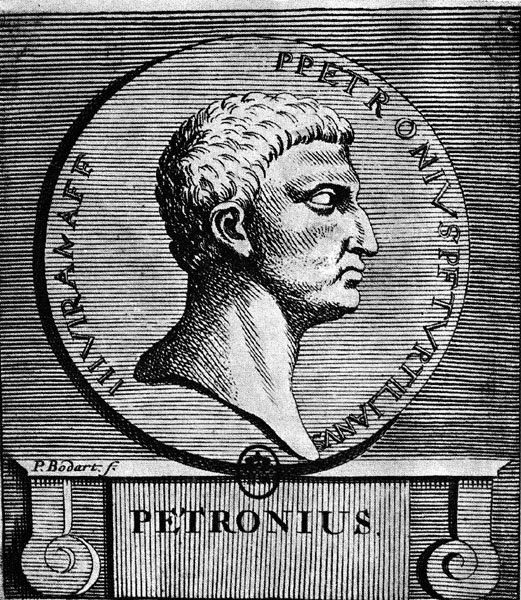
Petronius
c. 27-c. 66 CE
Petronius was the Emperor Nero’s “arbiter of elegance” until he fell out of favour and died by an elaborate suicide in or around 66 CE.
Petronius 28
Kissing is better than sex
Foeda est in coitu et brevis voluptas
Kissing is better than sex, says Petronius