
As many nineteenth century European writers automatically would, the Swiss poet Keller turns to classical mythology to make a point about human nature. Hear his fine forest poem in the original German and follow in English here.
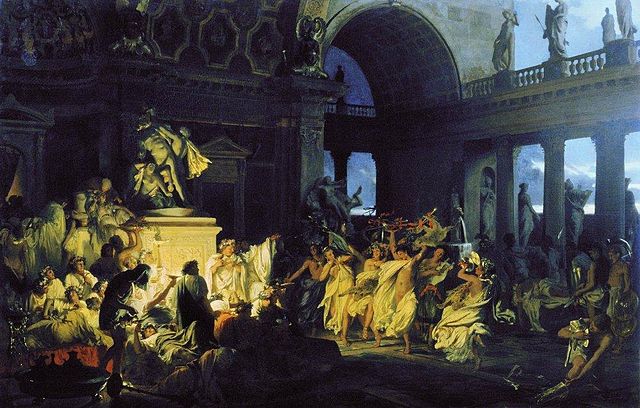
PantheonPoets.com is now one year old and recently posted its hundredth poem. Thank you for your company along the way.
There will be more to come in our second year from Horace and Virgil, Rome’s greatest lyric and epic writers. So far, there are 16 of Horace’s Odes, and extracts from the Aeneid have reached book seven (of twelve). There will be more Ovid, Catullus and Propertius, and new authors such as the scientist-philosopher Lucretius, from whom a first extract has recently been added.
The aim is to make the poetry as accessible and entertaining as possible, and finding an illustration for every poem is part of this. Another recent feature is a new series of selections of poems by different Latin authors on a common theme, so far including love, happy and unhappy, monsters, mourning and gods and demons. I hope that these will make it easier for you to go exploring if you are not necessarily a classicist. In time there will be a dozen or more of these selections: you will find them under the Latin Poetry tab.
“Modern” – in other words, post-classical – poetry continues to be an important part of Pantheon Poets. There is poetry from 16 authors so far, many chosen to show direct echoes or wider cultural influence from the classics. Do browse this “Other” poetry as well as the Latin and Greek. You may find surprises, including a mock-classical passage from Marcel Proust to celebrate his 150th birthday next month – he is not as widely appreciated for his jokes as he deserves to be.
You can keep informed about new poems using the “News” feed, which gives links to the poetry itself and to the illustrated blog. Or you can hear about new poems and see the illustrations by following us on Instagram (pantheon.poets): there is also a new feed there – realmsofgoldpoets – drawing attention to post-classical poetry at the Pantheon Poets website.
Poetry in modern languages other than English is performed at Pantheon Poets by mother-tongue readers, and I would like to give special thanks to my German, French and Italian friends Tatjana, Olivia and Daniel, as well as to Lahive Creative for their great work over the past year.
It has been a strange old year, but Boethius reminds us that the world keeps on turning:
semper vicibus temporis aequis
Vesper seras nuntiat umbras
revehitque diem Lucifer almum. *
Pantheon Poets and I wish you joy, fulfilment and freedom in the year to come.
Marcus Agrippa
*Forever, to the steady beat of time, the evening star says lateness and the dark, the morning star brings back the kindly day.


See the opening of the greatest English epic poem here, with links so you can compare it with its classical models, the Aeneid, Iliad and Odyssey. In the illustration by William Blake, an Archangel warns Adam and Eve in the Garden of Eden. In the background, beyond the Tree of Knowledge, an elephant “wreathes his lithe proboscis” (Paradise Lost Book 4, line 347).
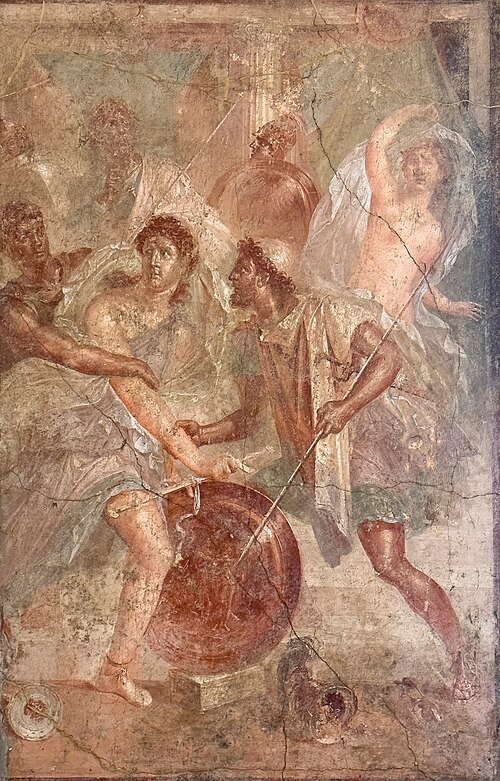
In one of his odes, Horace refers to the legend that Thetis, the mother of Achilles, hid him disguised as a girl in the household of King Lycomedes of Skyros to prevent him from going to his death in the Trojan war; but that Odysseus and Diomedes tricked him into revealing himself by making him think the palace was under attack (he grabbed a weapon).
Hear the poem in Horace’s original Latin and follow in English here.
Photo by Chappsnet, CC BY-SA 4.0 , via Wikimedia Commons
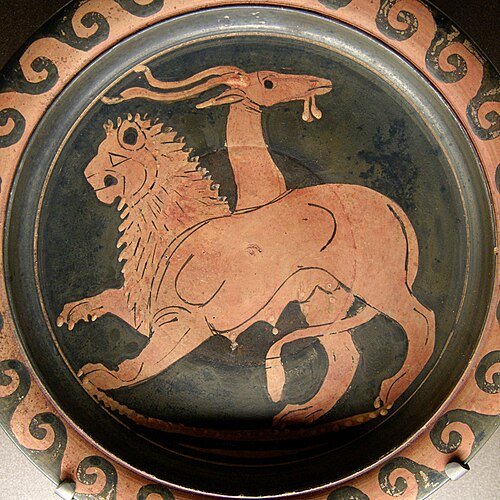
In a poem swearing friendship to his patron Maecenas, Horace declares that not even the fabled Chimera could tear them apart.
Hear this moving poem and follow in English here.
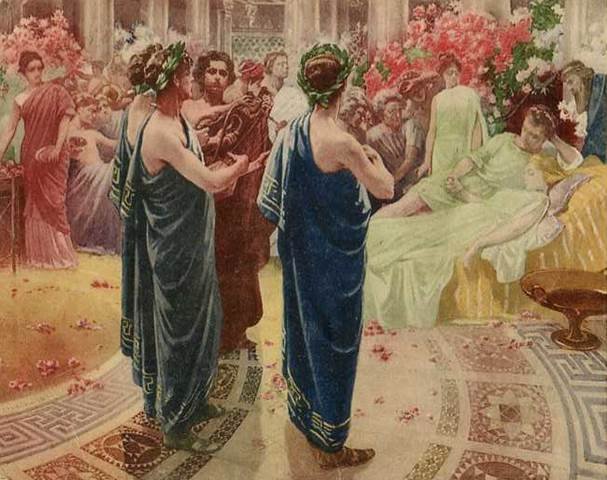
A little poem complaining at the grossness of sex and the dejection that can follow it is credibly ascribed to Gaius Petronius Arbiter, sometime favourite of the aesthete-Emperor Nero. It is better, says the poem, to stick to kissing. Hear this curious piece, which shares something of the outlook of the decadents of the late nineteenth century, and follow in English, here.
The illustration is an artist’s impression Petronius’s final moments as he died by an elaborate suicide after his fall from grace, in an illustration from Sienkiewicz’s novel, Quo Vadis?