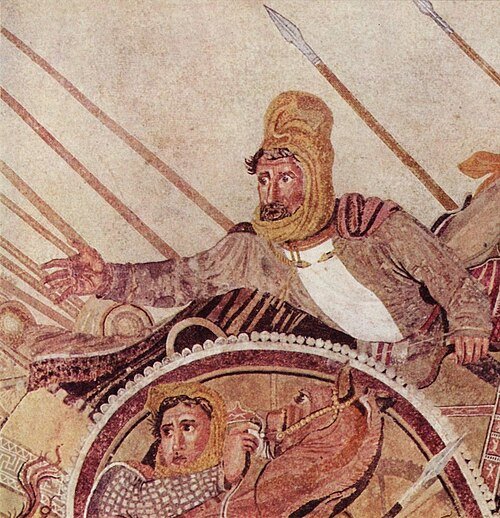
Looking for an example to show why wealth is not necessarily the key to happiness, Horace chooses Phraates, who was restored to the throne of Parthia in 25 BCE. The message is that the crown and authority of a king must always be uncertain: only the man who can maintain a philosophical indifference to such things can truly possess them.

The illustration shows a famous mosaic from Pompeii of Alexander the Great defeating King Darius, an earlier holder of the “throne of Cyrus” at the battle of Issus, some three centuries before Horace’s time.

Hear Horace’s Latin and follow in English here.

In the last poem of his first book of Odes, Horace celebrates with a drink in the shade of a closely tangled vine, served by a single slave. Both wear myrtle crowns for the occasion, chosen for their simplicity, as Horace stresses. The garland that the beautiful Antinous wears in this bust from the British Museum is of ivy, sacred to Bacchus/Dionysus.

Hear Horace’s poem in his original Latin and follow in English here.

Privacy Overview

This website uses cookies so that we can provide you with the best user experience possible. Cookie information is stored in your browser and performs functions such as recognising you when you return to our website and helping our team to understand which sections of the website you find most interesting and useful.