From Book 12 of the Metamorphoses, Ovid describes the mysterious realm where all that happens in the world is seen, heard and commented on. Hear his Latin and follow in English here: see the illustrated blog post here.

Ovid has finally succeeded with Corinna and seems rather pleased about it. Hear the poem and see the translation here.
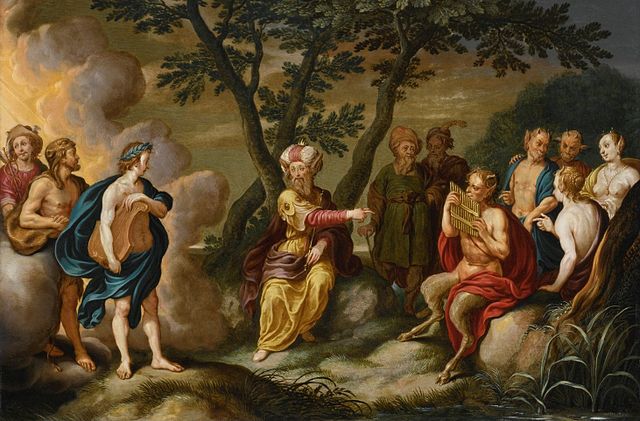
In his poem, the Metamorphoses, Ovid is telling the story of King Midas, who should have been more careful what he wished for. In today’s blog illustration, Midas is shown demonstrating that his poor judgement in asking for the golden touch was not a one-off: he is awarding Pan the victory in a musical competition against the God Apollo. See and listen to the poem here.

Palinurus the great navigator and helmsman is betrayed and thrown overboard by the God of Sleep. The Gods have decreed that his life is the price of his companions’ safe onward journey: he will become the archetype, down the ages, of the poor mariner lost at sea. Hear the extract here.
Illustration: Wikipedia Loves Art participant “Opal_Art_Seekers_4“, WLA taft Plate with Palinurus Overboard, CC BY 2.0


In the battle between the Trojans and Rutulians, Turnus, the Italian leader, and Pallas, the young Arcadian Prince, confront one another – Pallas fights bravely, but the match is an uneven one. Hear the combat in Virgil’s Latin and follow in English here.

As many nineteenth century European writers automatically would, the Swiss poet Keller turns to classical mythology to make a point about human nature. Hear his fine forest poem in the original German and follow in English here.
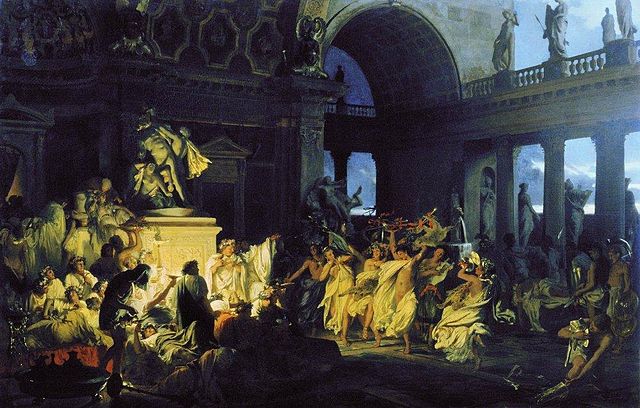
PantheonPoets.com is now one year old and recently posted its hundredth poem. Thank you for your company along the way.
There will be more to come in our second year from Horace and Virgil, Rome’s greatest lyric and epic writers. So far, there are 16 of Horace’s Odes, and extracts from the Aeneid have reached book seven (of twelve). There will be more Ovid, Catullus and Propertius, and new authors such as the scientist-philosopher Lucretius, from whom a first extract has recently been added.
The aim is to make the poetry as accessible and entertaining as possible, and finding an illustration for every poem is part of this. Another recent feature is a new series of selections of poems by different Latin authors on a common theme, so far including love, happy and unhappy, monsters, mourning and gods and demons. I hope that these will make it easier for you to go exploring if you are not necessarily a classicist. In time there will be a dozen or more of these selections: you will find them under the Latin Poetry tab.
“Modern” – in other words, post-classical – poetry continues to be an important part of Pantheon Poets. There is poetry from 16 authors so far, many chosen to show direct echoes or wider cultural influence from the classics. Do browse this “Other” poetry as well as the Latin and Greek. You may find surprises, including a mock-classical passage from Marcel Proust to celebrate his 150th birthday next month – he is not as widely appreciated for his jokes as he deserves to be.
You can keep informed about new poems using the “News” feed, which gives links to the poetry itself and to the illustrated blog. Or you can hear about new poems and see the illustrations by following us on Instagram (pantheon.poets): there is also a new feed there – realmsofgoldpoets – drawing attention to post-classical poetry at the Pantheon Poets website.
Poetry in modern languages other than English is performed at Pantheon Poets by mother-tongue readers, and I would like to give special thanks to my German, French and Italian friends Tatjana, Olivia and Daniel, as well as to Lahive Creative for their great work over the past year.
It has been a strange old year, but Boethius reminds us that the world keeps on turning:
semper vicibus temporis aequis
Vesper seras nuntiat umbras
revehitque diem Lucifer almum. *
Pantheon Poets and I wish you joy, fulfilment and freedom in the year to come.
Marcus Agrippa
*Forever, to the steady beat of time, the evening star says lateness and the dark, the morning star brings back the kindly day.