Horace describes a lively party to welcome Numida home from Spain: hear the poem in the original Latin and follow in English here; see the illustrated blog post here.

At first glance there is not much in this poem to remind us of Latin, except perhaps for the “murmuring labours” of the Etonians studying their vocab or irregular verbs. However, it is pure “carpe diem”, and the personified human misfortunes it lists are a pretty close borrowing from Book 6 of the Aeneid. See the Aeneid text, and the whole of the Gray poem, here.
The picture is one of a sequence illustrating the poem by William Blake.

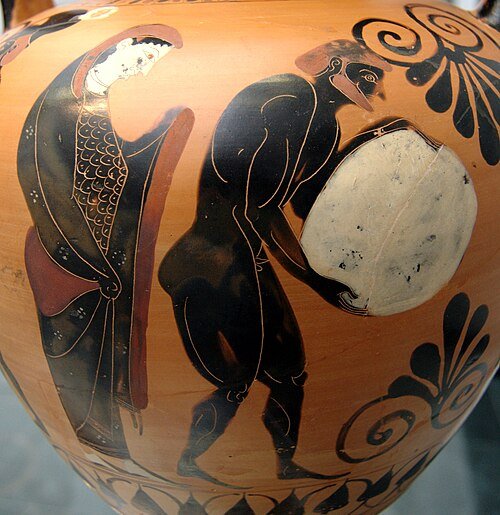
The Cyclops can no longer see, but sits at the mouth of the cave, blocking the way to freedom. Again, the resourceful Odysseus has a plan. Hateful as he is towards men, the Cyclops shows a touching affection for his flock.
Hear Homer’s Greek and follow in Samuel Butler’s English here.
Image courtesy of the British Museum under licence CC BY-NC-SA 4.0.

Hear the story of the Cyclops in Homer’s Greek with an English translation at PantheonPoets.com. Starting today, we post the whole story from Book 9 of the Odysssey, one of the best and earliest travellers’ tales in European literature, in seven daily parts.
Why in the original? Because translations can’t convey the contribution that the sound of the ancient Greek language makes to the story, or the way in which Homer’s hexameter poetry sweeps the story along.
To do full justice to the performance of Homer’s Greek, a reader should have an absolute command of Homeric metre, which is irregular, complex and sometimes inconsistent, a native speaker’s pronunciation, the skills of a first-rate actor and a time machine to travel back to learn how the tonal aspects of the language – a bit like modern Chinese – actually worked, a question obscured by the passage of almost three millennia and subject to considerable dispute. We cannot claim all of these desirables, or indeed any of them in full, but hope that our careful research and best efforts will make the wonderful story worth listening to, and convey some of the narrative drive, drama and excitement that the Greek original will retain for ever.
Hear Homer’s original Greek and follow in Samuel Butler’s English translation here.
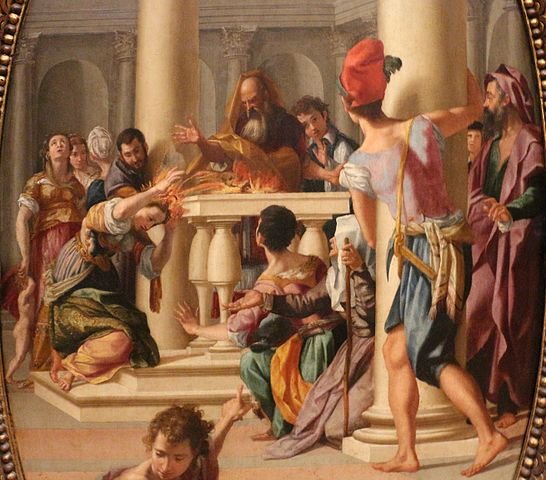
It is time for Lavinia, the only child of King Latinus of Latium, to marry. Her mother, the Queen, has definite plans, but the omens are unfavourable, including a horrifying accident as Lavinia’s hair catches fire at the altar.
Hear the Latin and follow in English here.
Boethius’s fifth-century version of the Orpheus and Eurydice legend is more than just a literary exercise: it is a meditation on light, darkness, life and death written in prison by a man who knew that a grim death awaited him soon.
Hear Boethius’s Latin and follow in English here.