After the battle, Aeneas and his Trojans count the cost. Hear Virgil’s Latin and follow in English here, and see the illustrated blog post here.

As well as acting as the messenger of the Gods, Hermes (Mercury to the Romans) was envisaged in the ancient world as the god of boundaries. Perhaps because of this, he is also sometimes represented as the guide who accompanies the souls of the dead to the underworld. Perhaps the most famous example is in the final book of the Odyssey, when he performs this function for the souls of Penelope’s suitors when Odysseus has killed them on his return to his home on the island of Ithaca.
Horace refers to this attribute of Mercury in an ode mourning the death of an upright and respected Roman named Quintilius. The academic evidence on precisely who Quintilius may have been is inconclusive, but Horace makes it clear that he was a dear friend of the poet Virgil.
Hear Horace’s Latin and follow in English here.

Aeneas learns from his ships, which have been transformed into sea- nymphs by the Goddess Cybele, that his son, Ascanius, and his Trojan force are being hard-pressed by the Rutulian leader, Turnus. Hear the Latin and follow in John Dryden’s classic 17th-century translation here.

Propertius has been invited by his friend Tullus to go with him to Greece and Asia, but concern about Cynthia’s reaction keeps him at home.
Hear Propertius’s Latin and follow in English here.

In a charming poem tinged with darker themes and written in elegant Alcaic metre, Horace reflects on the destructive power of anger, and promises a lovely mother and her even lovelier daughter that he will never return to writing iambics – a metre famed among the Greeks and Romans for personal attacks and lampoons. In the illustration by the Japanese woodblock print designer Utamaro, a lovely mother teaches her even lovelier daughter the art of calligraphy.
Hear Horace’s Latin and follow in English here.
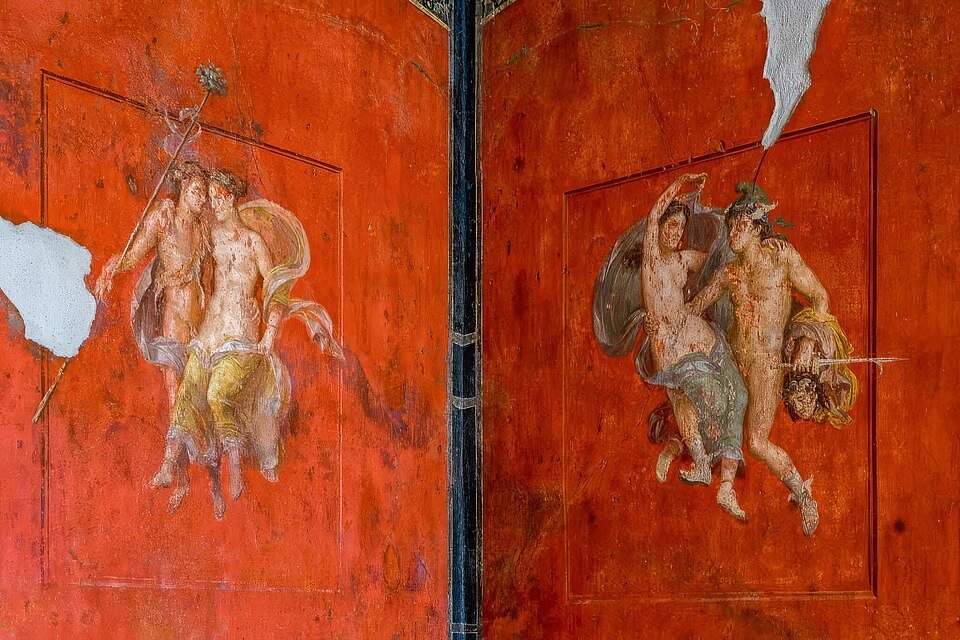
Horace describes a welcome-home party for the homecoming of Numida, probably a soldier, from Spain. Horace makes it very clear that there is no shortage of drink, and that love (or sex, at least) is definitely in the offing; he himself, a little incongruously, seems more of an onlooker than a partygoer. The floating couples in the illustration come from a Pompeiian fresco. Hear the poem in the original Latin and follow in English here.