Today we publish all 20 of the Horace Odes so far on Pantheon Poets as a single selection in reference order. Access it here to hear the poetry in the original Latin and follow in English translation.

In paying a compliment to one of his patron, Maecenas’s, friends, Horace is describing a party. Live it with him, from the original idea to the finale in the small hours, in just 125 words. The party about to go with a swing in the illustration, by Anselm Feuerbach, is Greek; but then, so is almost everything about Horace’s little gem of a poem except for the language.
Hear Horace’s Latin and follow in English here.

Horace writes again about love, this time from the point of view of middle age. Others, he says, are now better suited to dedicating marble statues to Venus and her powers.
Hear Horace’s Latin and follow in English here.

In this Ode, a dramatic monologue, Horace’s protagonist is keeping the peace at a vaguely Greek drinking-party that threatens to degenerate into a brawl. He distracts his companions by ribbing one of the company about a current love-affair – with a woman who, in the speaker’s opinion at least, is a spectacularly bad choice.
Hear Horace’s Latin and follow in English here.

Horace usually avoids the great traditional themes and stories of epic poetry, but here he uses the new lyric style that he has developed from Greek predecessors to create an innovative poem about the Trojan war.
In a fresco from Pompeii, Helen boards a ship for Troy.
Hear Horace’s Latin and follow in English here.
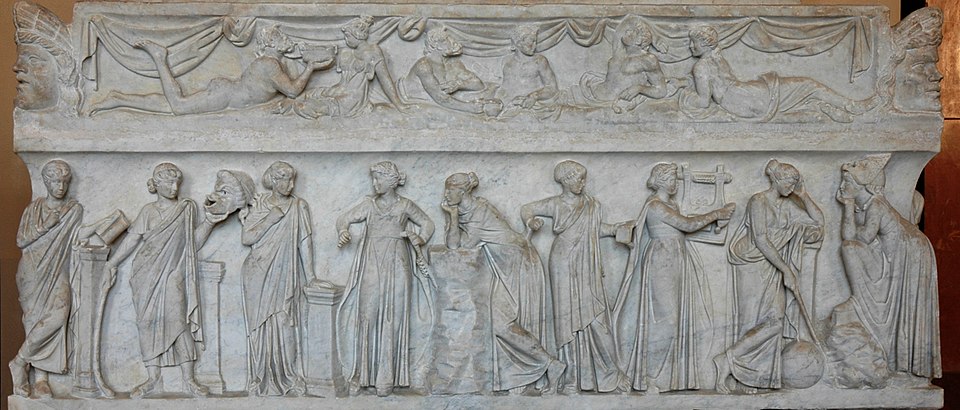
Horace pays reverence to the divine favour that (he says) he enjoys from the Muses, while asserting his poetic skill and gift for innovation in a small masterpiece which he presents as a floral garland for a dear Friend, Lamia.
Hear Horace’s original Latin and follow in English here.
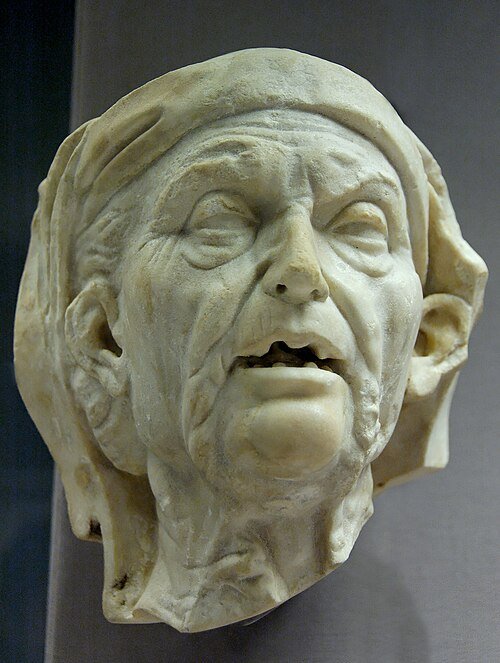
An old woman is insisting on chasing boys who are more her daughter’s age and cramping the style of the young girls on whom she is forcing her company. Whether Horace’s poem is a piece of pure comedy or something more, the moralising tone, albeit light-hearted, is in line with the return the traditional moral standards which Augustus, the first Emperor of Rome, hoped to reintroduce to the (sometimes freewheeling) upper classes. Hear Horace’s Latin and follow in English here.
The illustration comes from a Roman sculpture of an old woman.