Saturnalia on 17 December was the Roman’s midwinter party festival. It had a definite topsy-turvy element, with masters waiting on their slaves, as shown in the illustration, and a generally indulgent attitude towards high jinks.
Today’s poem was written for a different occasion: it is an extract from one of Virgil’s pastoral poems, or Eclogues, written in 40 BCE and looking forward to a birth which will herald the start of a new golden age. It is appropriate to the run-up to Christmas because, though few if any would agree today, a strong current of opinion among early Christians and in the middle ages interpreted it as a prophesy of the birth of Christ. Hear the Latin and follow in English here.

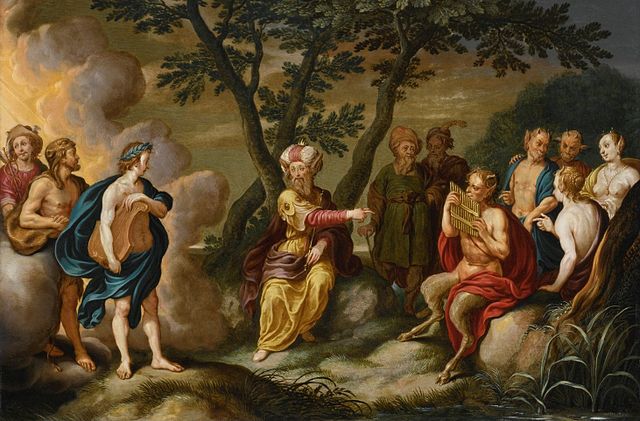
In his poem, the Metamorphoses, Ovid is telling the story of King Midas, who should have been more careful what he wished for. In today’s blog illustration, Midas is shown demonstrating that his poor judgement in asking for the golden touch was not a one-off: he is awarding Pan the victory in a musical competition against the God Apollo. See and listen to the poem here.

After stabbing herself, Dido lingers on in pain until Juno, Queen of the Gods, takes pity and sends Iris, the Goddess of the rainbow to set her finally free. See and hear the passage here.

Today’s new poem is by Horace, celebrating a feast day with wine in an uncloudedly happy mood, and thinking ahead to the evening. You can hear it here.
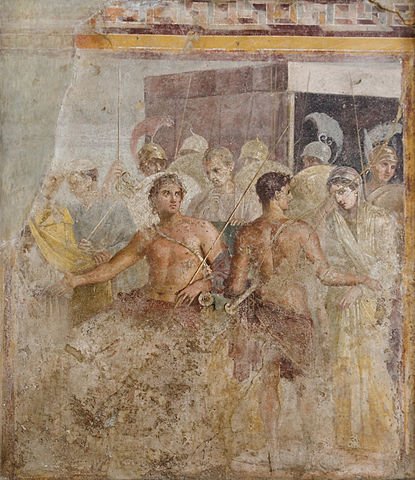
Homer’s great poem begins with the origins of the strife between King Agamemnon and the supreme warrior Achilles that brought the Greek army to the brink of defeat on the plains and seashores in front of the city of Troy. Hear the opening in Greek and follow an English translation here.

Horace’s poem is addressed to his friend Septimius and praises the attractions of Tarentum on the heel of Italy, to which Septimius seems to have a connection. Hear it with a translation here.
Illustration: Maria, Testa di donna (Taranto), CC BY-SA 2.0

Friedrich von Schiller, the great contemporary of Goethe, was a gifted translator of Virgil. You can find his version of the death of Laocoon recited and translated here.

The Trojan priest Laocoon pays the price for warning his fellow-citizens against bringing the Trojan horse into the city, as monstrous serpents crush first his two sons then Laocoon himself in their coils. Not only can you follow the Latin here, you can now also hear the poets Friedrich Schiller’s fine German version in our “Other Poems” section here.

Laocoon warns his fellow-Trojans not to take the Trojan horse into their city. Hear the Latin and follow the English here.