Horace shows respect and affection in this invitation-poem to his patron Maecenas and pays a compliment to the future Emperor Augustus into the bargain.
Hear the Latin and follow in English here.

Horace shows respect and affection in this invitation-poem to his patron Maecenas and pays a compliment to the future Emperor Augustus into the bargain.
Hear the Latin and follow in English here.

Catullus thought that Suffenus was a dud as a poet but – against form – was prepared to make allowances for the inability that we all have, as humans, to see ourselves as we are. The illustration shows that even real talent may get carried away by its own publicity …
Hear the Latin and follow in English here. The photograph of Oscar Wilde is by Sarony.
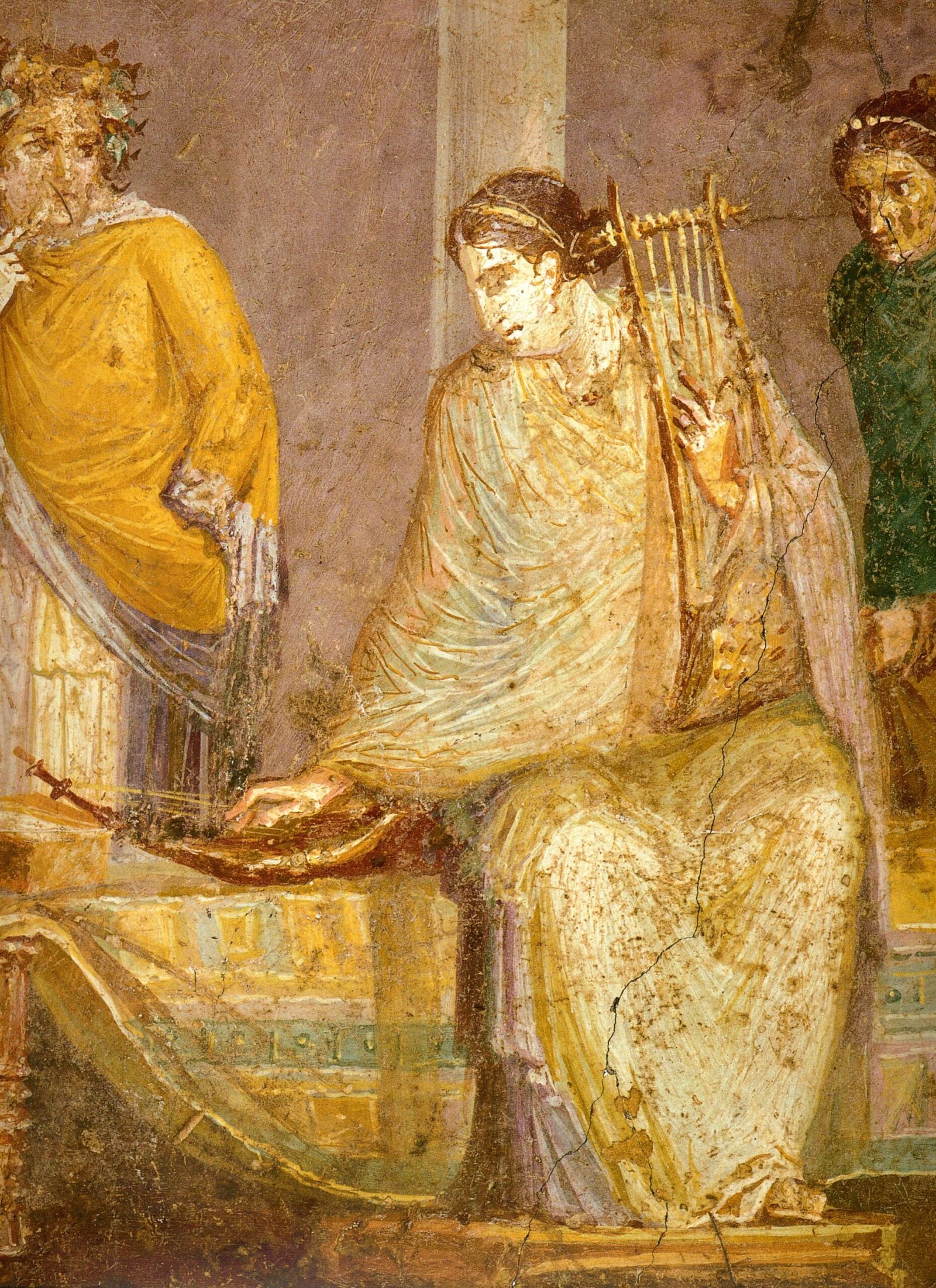
In Apollo’s newly-dedicated temple, Horace prays for the things that matter to him. The dedication has been an important public occasion, but his poem has a very personal feel, as he looks ahead to an old age to which he is resigned – provided he retains health, his mental faculties and the ability to write and enjoy poetry. Hear Horace’s original Latin and follow in English here.
In the illustration , a fresco from Pompeii, a cithara player cradles her instrument.

In a piece which seems to have been written at a dangerous point some years before Horace launched his first three books of odes in 23 BCE, he turns for help to the Goddess Fortuna, while recognising that the fortunes that she has in store for Rome after a long period of civil wars could be bad as well as good. This ode seems as deeply and personally felt as any that Horace wrote, and is surely no mere literary exercise.
In the illustration, from a mediaeval manuscript of the Carmina Burana, Fortuna governs the cycle of life.
Hear Horace’s Latin and follow in English here.

Acting as a priest, the Trojan Helenus, now by a favourable reverse of fortunes the ruler of Achilles’s former kingdom, makes a curious prophecy that centres on a white sow with thirty piglets. Perhaps he had covered his head to officiate at the sacrifice, as was the later Roman custom. The Roman shown here is the Emperor Augustus, dressed as the Pontifex Maximus (High Priest). Hear the poem in Latin with an English translation here.

Are the Olympian Gods – if they exist – too remote to take an interest in human affairs, as the followers of the Philosopher Epicurus thought? An awe-inspiring natural event causes Horace to think again about his beliefs. Hear Horace’s Latin and follow in English here.
In this wall painting from Herculaneum, Zeus and Hera celebrate their marriage; see photo credits for licensing details.