Saturnalia on 17 December was the Roman’s midwinter party festival. It had a definite topsy-turvy element, with masters waiting on their slaves, as shown in the illustration, and a generally indulgent attitude towards high jinks.
Today’s poem was written for a different occasion: it is an extract from one of Virgil’s pastoral poems, or Eclogues, written in 40 BCE and looking forward to a birth which will herald the start of a new golden age. It is appropriate to the run-up to Christmas because, though few if any would agree today, a strong current of opinion among early Christians and in the middle ages interpreted it as a prophesy of the birth of Christ. Hear the Latin and follow in English here.


Myths that we think we definitely know could appear in differing versions in the ancient world. One example is the marriage of Venus, Goddess of love, to Vulcan, the lame craftsman-God who forged Jupiter’s thunderbolts for him. Interestingly, they are shown as married to one another in the Odyssey, but not in the Iliad, a small but interesting snippet of potential evidence in the debate over whether the two poems were created by the same author. Anyway, by the time of Ovid and Augustus, and in Vigil’s Aeneid, the two were firmly spliced. Hear Ovid’s account of an adulterous affair between Venus and Mars, the glamorous war-God, here. (Could the trouble that Ovid got into with Augustus, leading to his exile to the back of beyond, have had something to do with the fact that the Emperor was campaigning against the looseness of morals in Rome, and that he claimed Venus as his many-times-great-Grandmother?)
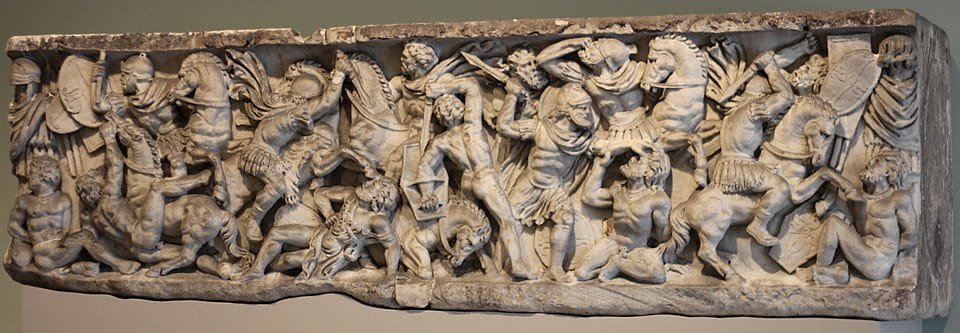
Horace opens his second book of odes with a resounding tribute to a fellow writer, Gaius Asinius Pollio. Pollio was what we sometimes call a Renaissance man. Until 39 BCE, he was a major political and military figure, who held the consulship and earned a triumph by his military success: thereafter, he was distinguished as a tragic playwright before picking up the threads of a history of the civil wars which his predecessor, Sallust, had died without completing. Though Horace demurs, the poem is a fine example of his ability to deal vividly in lyric verse with subject-matter usually regarded as the domain of epic poetry. Hear Horace’s Latin and follow in English here.

As Horace brings the final book of his Odes to an end, an idealised Roman family of the future gathers to sing Augustus’s praises and give thanks for the peace and the imperial power that he has brought to Rome.
Hear Horace’s Latin and follow in English here.

A pining lover is locked out. Who’s to blame? The door, of course! This one has seen much better days (and much better morals)! See the poem here.