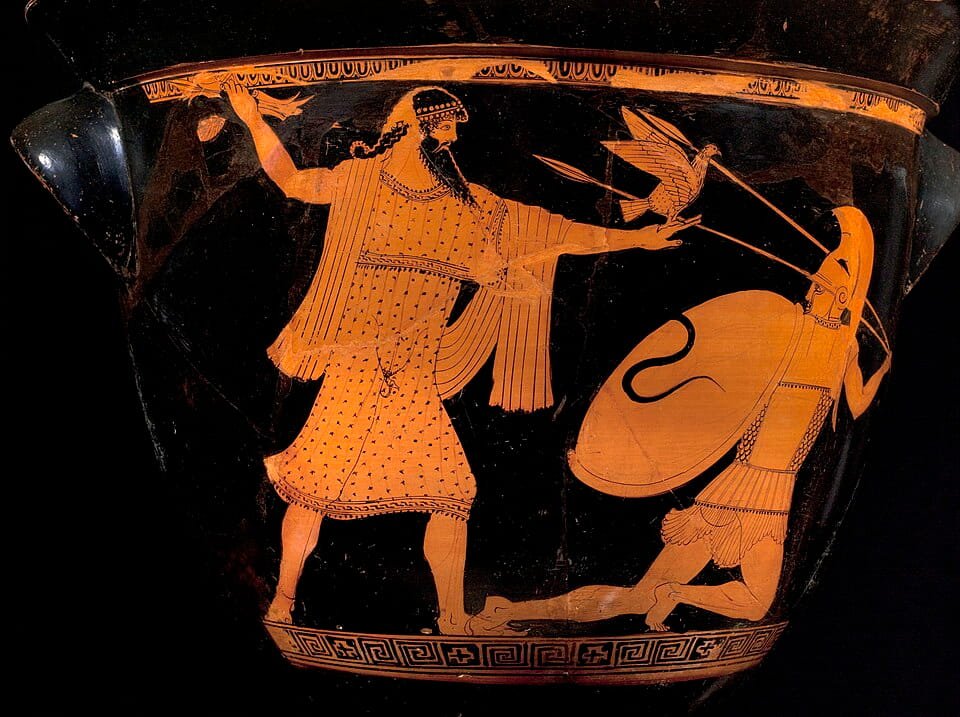
In his longest ode, the fourth in a series of six weighty Alcaics reviewing the social, political, moral and military condition of the world of Rome, Horace claims divine inspiration when he uses the example of the war between the Gods and the Titans in Greek mythology to assert that revolt against just authority is unwise and will lead to retribution. The lessons for Rome in the 20s BCE, when Octavian/Augustus, was consolidating his power, are not hard to see.

On an Attic bell-crater of circa 470 BCE, Zeus fells the Titan Porphyrion with a thunderbolt.

Hear Horace’s Latin and follow in English here.

Echoing Stoic philosophy, Horace commends indifference to riches and makes the point that they are of value only when put to use. Hear Horace’s Latin and follow in English here; see the illustrated blog post here.

Odi profanum volgus et arceo, omne capax movet urna nomen, post equitem sedet atra cura – “I despise the profane crowd, I banish them”; “(Destiny’s) capacious urn shakes every name together”; “behind the rider sits black Care”. These, among Horace’s most famous phrases, all occur in the first poem in his third book of Odes. It is “carpe diem” with a difference: the more you have, the more there is for you to worry about, and the answer is to be content with modest comforts and avoid the temptations of greed and excess. It is no coincidence that, at the time, the Emperor Augustus was championing a return to simpler, ancestral, Roman values. Hear Horace’s Latin and follow in English here.

Suffering from insomnia, the poet John Westbrook recalls the sleeplessness of Achilles. In the illustration, an Attic vase of circa 450 BCE, Achilles tends the wounded Patroclus. See Westbrook’s poem here.

The latest in Pantheon Poets’ sequence of ancient and modern poems about swans is W B Yeats’s “The Wild Swans at Coole”. Hear it read by Harry McFarland here and see the illustrated blog post here.

Privacy Overview

This website uses cookies so that we can provide you with the best user experience possible. Cookie information is stored in your browser and performs functions such as recognising you when you return to our website and helping our team to understand which sections of the website you find most interesting and useful.