In today’s post, Aeneas learns what he must do to gain entry to the underworld to see his dead father. Hear the Latin and follow in English here and see the blog post with a painting by Turner here.

Aeneas is told by the Cumaean Sybil that the way to the underworld can be opened to him only if he finds a golden bough, sacred to Proserpina, Queen of the underworld, and takes it with him as an offering. The illustration shows the golden bough as imagined by JMW Turner. Hear the Latin and follow the English translation here.

Farmers have an easy life, according to Virgil in his Georgics. But would they agree? Hear Virgil’s rose-coloured poem in Latin and follow in English here.
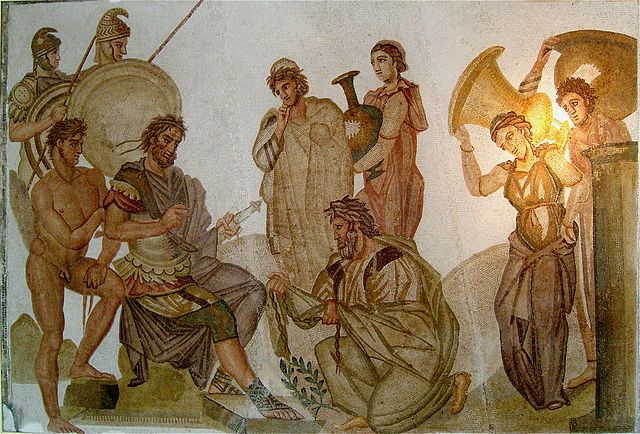
Following a period of revision to catch up on our slightly rusty Greek, including some research and experimentation on pronunciation, we have made a new recording of the first twenty-one lines of the Iliad, which tell how the quarrel, on the results of which the whole poem turns, began between Agamemnon, the high King of the Greek forces besieging Troy, and Achilles, the mightiest of all the Greek warrior-chieftains.
There is a pretty good consensus in the academic world about how, syllable by syllable, Greek words should be pronounced. Unfortunately, just what the language sounded like is probably lost beyond recall. In particular, Greek in ancient times was a tonal language, in which the pitch at which a syllable was spoken mattered, as well as the pronunciation of its vowel sound and whether it was sounded long or short. We experimented with the tonal approach and studied a number of brave readers, who can be found on You Tube and elsewhere, who have attempted it. We ourselves found that the unfamiliarity of a tonal rendering, and a certain tendency for it to “flatten-out” the flow of the poetry and give it a sing-song quality that detracted from the grandeur and pathos of the narrative, were real drawbacks. We have therefore followed the view of Professor W. Sidney Allen, author of “Vox Graeca”, the standard scholarly work on Greek pronunciation, who advised against attempting a tonal rendering, instead concentrating on accuracy and consistency in other respects. We hope you enjoy the results: you can link to them here.