The tide of battle turns against Aeneas and his men as their Greek disguise backfires and their attempt to rescue princess Cassandra fails.
Hear Virgil’s Latin and follow in English here; see the illustrated blog post here.
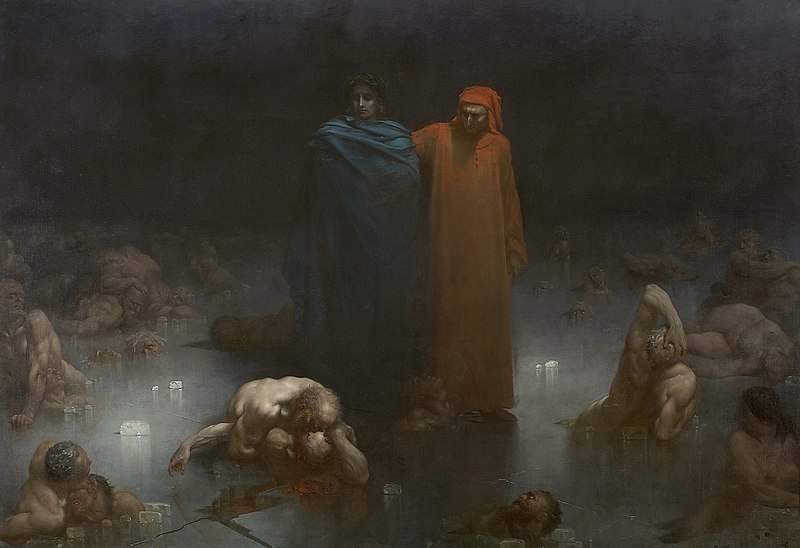
The Sibyl has shown Aeneas on his underworld journey the citadel of Tartarus: now she tells him of the torments suffered by the guilty souls imprisoned there. Hear the Latin and follow in English here. In the illustration, Virgil conducts Dante on their later journey through the Inferno.
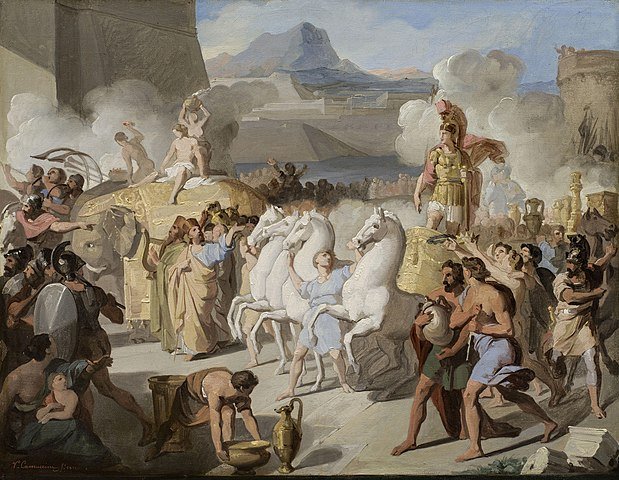
In today’s extract, Aeneas learns in his journey to the underworld of Marcellus, the Emperor Augustus’s nephew. Augustus adopted him as his son and prospective successor and heir in 25 BCE, when he was still only a teenager. It was not to be: Marcellus would die only two years later with his potential unfulfilled. The illustration shows what might have been: the general making a triumphant entry to Rome may be the Marcellus with whose shade Aeneas sees the young man walking, an illustrious war leader of the third century BCE.
Hear the extract in Latin and follow in English here.

This poem by Schiller, “Nänie” (meaning a Roman funeral song) is famous in the German-speaking world. It is a fine example of how influential classical education, which most significant European writers between the Renaissance and the mid-twentieth century would have had, was on their work. Schiller actually uses an ancient Greek and Roman metre – elegiac couplets – and takes it as read that his audience will immediately recognise the figures from myth that he refers to, although only one of them is referred to by name in the German text.
The illustration shows the courtship on a red-figure cup of Thetis, the grieving mother of Schiller’s poem, and the hero Peleus. Thetis, a shape-shifter, attempts to elude him by using her gift, but he holds her too tightly. Achilles, also a figure in Schiller’s poem, will be among the results.
Hear Schiller’s German read by Tatjana Pisarski and follow in Westbrook’s English here.
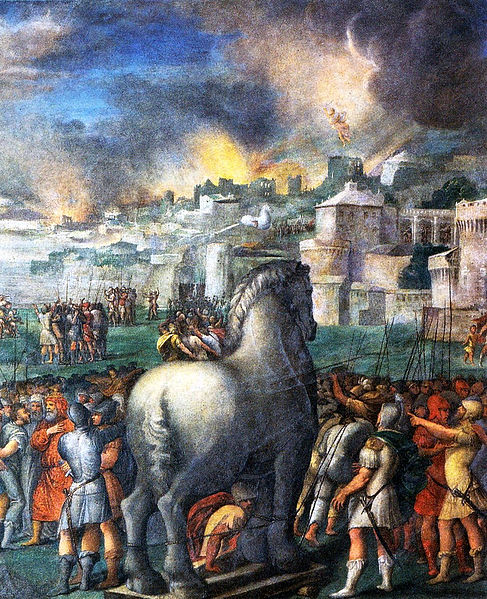
As Aeneas tells Dido of the fall of Troy, there could not be a sadder contrast between the joyful celebration that Aeneas describes and the dark events that are to come. Follow the extract in English and hear it in Latin here.

Dido, bereft, watches in despair as Aeneas and the Trojans ready their ships to sail away and leave her. Hear the poetry here.

When the Cyclops lights his evening fire, he spots Odysseus and his Ithacans. In the fraught exchanges which follow, it rapidly becomes clear that they cannot rely on the monster observing the ancient world’s sacred code of hospitality, and Odysseus realises that, even if he kills the monster, he and his comrades are trapped in the cave. But the resourceful Odysseus thinks of a plan.
Hear Homer’s Greek and follow in Samuel Butler’s English here.
The image, by Francisco de Goya, is of Saturn devouring one of his children.