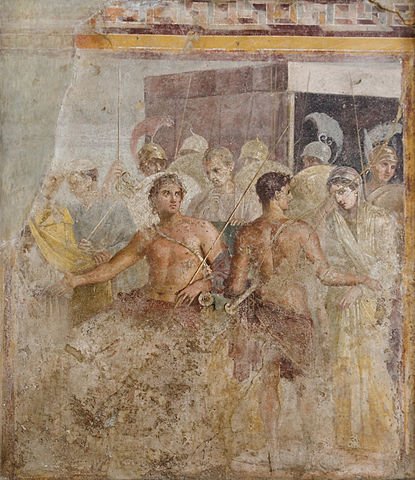
Homer’s great poem begins with the origins of the strife between King Agamemnon and the supreme warrior Achilles that brought the Greek army to the brink of defeat on the plains and seashores in front of the city of Troy. Hear the opening in Greek and follow an English translation here.

Horace’s poem is addressed to his friend Septimius and praises the attractions of Tarentum on the heel of Italy, to which Septimius seems to have a connection. Hear it with a translation here.
Illustration: Maria, Testa di donna (Taranto), CC BY-SA 2.0

Friedrich von Schiller, the great contemporary of Goethe, was a gifted translator of Virgil. You can find his version of the death of Laocoon recited and translated here.

The Trojan priest Laocoon pays the price for warning his fellow-citizens against bringing the Trojan horse into the city, as monstrous serpents crush first his two sons then Laocoon himself in their coils. Not only can you follow the Latin here, you can now also hear the poets Friedrich Schiller’s fine German version in our “Other Poems” section here.

Laocoon warns his fellow-Trojans not to take the Trojan horse into their city. Hear the Latin and follow the English here.

On a pyre she has built to burn all that Aeneas has left her, Dido dies by her own hand on his sword. It is one of the great moments of the Aeneid, and augurs enmity and war for the future between Dido’s and Aeneas’s descendants. Hear the climax of the story here.

Did you miss … Aeneas preparing to tell Dido the story of the fall of Troy? Hear the poem in Latin and follow it in English here.

The statesman and scholar Boethius, writing in prison before his execution, reminds us that some things in the Universe remain forever true and do not change. Hear the poem here.

Dido, bereft, watches in despair as Aeneas and the Trojans ready their ships to sail away and leave her. Hear the poetry here.