Which competitor will get to keep the beautiful Nearchus? See the illustrated blog post here, and hear Horace’s Latin and follow in English here.

In today’s Ode, Horace exclaims at the futility and presumption of the rich, who go in for grand building works, even encroaching on the sea in places like the luxurious seaside resort of Baiae. He prefers the simple life on his Sabine farm.
Horace uses Hipponactean metre, an unusual one found only here among his works. Hear his Latin performed in the original and follow in English here.
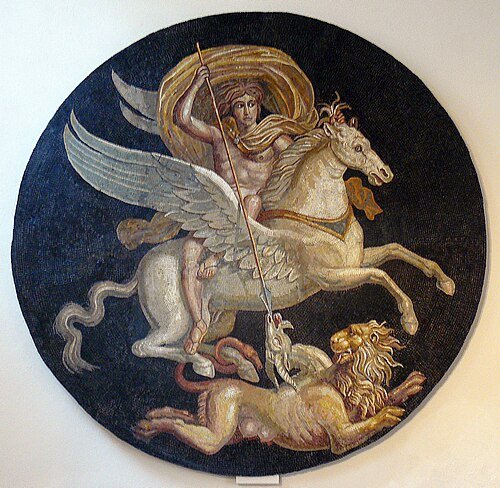
In this, the only poem that Horace (or any other Latin poet) ever wrote in the unusual metre of ionicus a minore, a young girl is distracted from her spinning and weaving by a handsome horseman who embodies all the martial skills and values that Augustus was keen to encourage in the Romans of his time. She (or is it Horace?) compares him to Bellerophon, the mythical rider who tamed Pegasus, the winged horse. The illustration is a Roman mosaic discovered in Autun.
Hear Horace’s Latin and follow in English here.

A E Housman was a professor of Latin as well as a famous poet of the life of the English countryside. Because of these twin talents, his translation of Horace’s “Diffugere nives” (Ode 4.7) captures its sentiment and mood perfectly although he uses English poetic techniques and convention which could hardly be more different than those of Latin poetry. All the more reason to encounter Latin poetry in the original, with a reading and a translation, at Pantheon Poets.
In the illustration, Theseus and Pirithous, whose legendary friendship is referred to at the end of the poem, rid the land of robbers and liberate abducted women.
See and hear Horace’s original alongside Housman’s translation here.
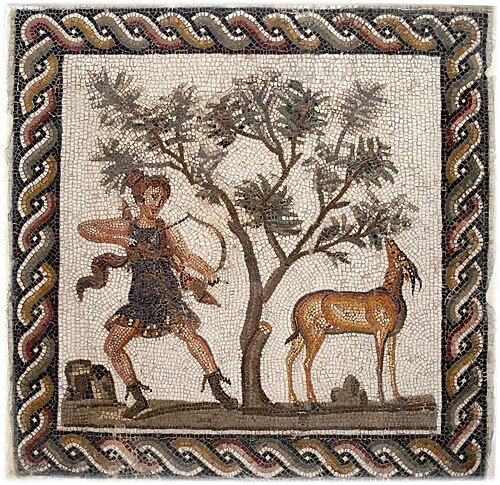
In a mysterious little poem, Horace consecrates a tree overhanging his villa to Diana and promises her the sacrifice of a boar-pig each year. Quite what the inspiration was is hard to say – as often, there are echoes of Greek literary form – but the detail of the pine tree and its location close to Horace’s country house seems too specific to be imaginary. There may be an association with Horace’s life – we read elsewhere in the Odes of a narrow escape when a falling tree narrowly missed him, and perhaps he is taking precautions against this one doing the same – or the explanation may lie simply in reverence for the Goddess because of her association with the woods and countryside that Horace clearly loved.
Hear Horace’s Latin and follow in English here.

Horace’s poem is addressed to his friend Septimius and praises the attractions of Tarentum on the heel of Italy, to which Septimius seems to have a connection. Hear it with a translation here.
Illustration: Maria, Testa di donna (Taranto), CC BY-SA 2.0