The lovers (or spouses) Asterie and Gyges are parted for the winter, and Gyges’s landlady is threatening to tell tales on him to her husband if he will not sleep with her – she sends a go-between to remind him that similar things happened to others in myth – not only the hero Bellerophon, but also Peleus, the father of Achilles. Asterie need not worry about Gyges’s faithfulness, as it turns out, but Horace feels the need to offer a word of advice to her as well.

In the illustration, Peleus struggles to maintain a hold on Thetis, Achilles’s mother, who was a goddess and a shape-shifter.

Hear Horace’s Latin and follow in English here.

See how Mount Soracte stands white with the deep snow … this is perhaps Horace’s most benign and attractive version of the carpe diem theme, with the stress on wine, warmth and love, rather than the inexorable journey to the grave. See and hear the poem here.

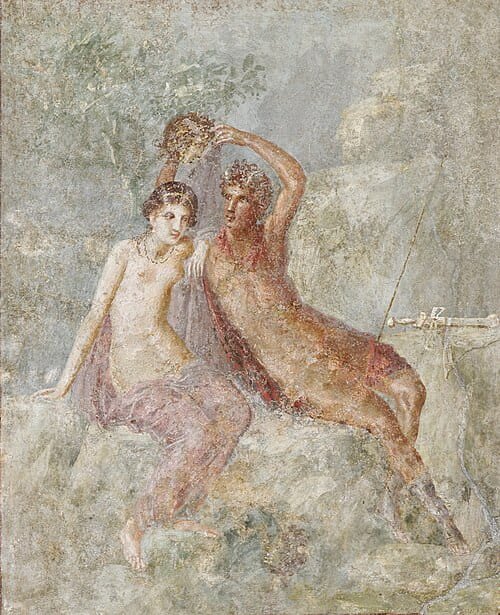
“The more a man denies himself gain, the more he will get from the gods.,” Horace tells his audience. This is all in line with the central teachings of Epicurean philosophy: aim for sufficiency and the absence of discomfort, rather than excess which arouses envy and wealth which brings care. The life which Horace represents as so frugal is none other than his own, led on his famous Sabine farm, a present from his wealthy patron and dear friend Maecenas, to whom the poem is addressed. Talking down the value of the gift to the extent that Horace does here could be seen as tactless, but, clearly, the warmth and closeness of their personal bond could cope with it. One of the examples that Horace quotes of wealth causing trouble is the story of Danae, to seduce whom Jupiter turned into a shower of gold, fathering the hero Perseus, shown with Andromeda, whom he rescued from a sea-monster, in this fresco from Pompeii.

Hear Horace’s Latin and follow in English here.


Tennyson combines his admiration for Milton’s poetry with his love of ancient poetry, and in particular his love of Alcaics, the Greek metre that Horace used for his loftiest themes in the Odes. You can decide for yourself how far the experiment succeeds, and use the links to compare Tennyson’s poem to some of Horace’s poems in the same metre, here.

The mental process by which Horace makes the link between the power of poetry and the story of the Danaids is a little mysterious, but the two are narrated in the first and second halves of this piece. All but one of the fifty daughters of Danaus, acting on his orders, murdered their husbands on their wedding night. We first find them in Hades, where their eternal punishment is to try to fill a huge jar with water, only for it to pour forever out through a hole in the bottom. The implied message to Lyde, the girl whom the speaker in the poem is pursuing, includes both a carrot and a stick: if she complies, she will be merciful and kind, like the one Danaid who did not commit the crime; if she is cruel, she will deserve some punishment for the hardness of her heart. Hear Horace’s Latin and follow in English here.

Privacy Overview

This website uses cookies so that we can provide you with the best user experience possible. Cookie information is stored in your browser and performs functions such as recognising you when you return to our website and helping our team to understand which sections of the website you find most interesting and useful.