
Aeneas learns from his ships, which have been transformed into sea- nymphs by the Goddess Cybele, that his son, Ascanius, and his Trojan force are being hard-pressed by the Rutulian leader, Turnus. Hear the Latin and follow in John Dryden’s classic 17th-century translation here.

At first glance there is not much in this poem to remind us of Latin, except perhaps for the “murmuring labours” of the Etonians studying their vocab or irregular verbs. However, it is pure “carpe diem”, and the personified human misfortunes it lists are a pretty close borrowing from Book 6 of the Aeneid. See the Aeneid text, and the whole of the Gray poem, here.
The picture is one of a sequence illustrating the poem by William Blake.
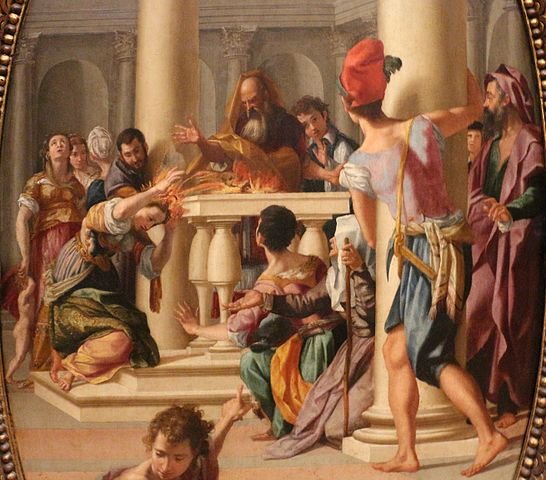
It is time for Lavinia, the only child of King Latinus of Latium, to marry. Her mother, the Queen, has definite plans, but the omens are unfavourable, including a horrifying accident as Lavinia’s hair catches fire at the altar.
Hear the Latin and follow in English here.

Palinurus the great navigator and helmsman is betrayed and thrown overboard by the God of Sleep. The Gods have decreed that his life is the price of his companions’ safe onward journey: he will become the archetype, down the ages, of the poor mariner lost at sea. Hear the extract here.
Illustration: Wikipedia Loves Art participant “Opal_Art_Seekers_4“, WLA taft Plate with Palinurus Overboard, CC BY 2.0


In the battle between the Trojans and Rutulians, Turnus, the Italian leader, and Pallas, the young Arcadian Prince, confront one another – Pallas fights bravely, but the match is an uneven one. Hear the combat in Virgil’s Latin and follow in English here.

Omens and prophecy are everywhere in classical literature, as this selection from the work of Virgil shows. In Book 2 of the Aeneid, the priest, Laocoon, foretells here all too Continue Reading