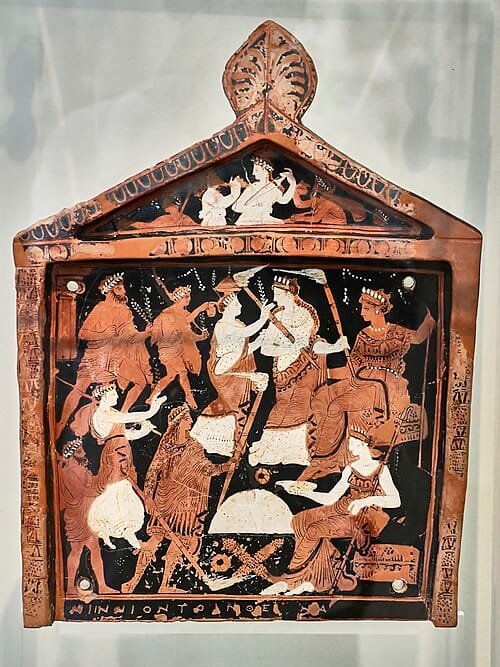
This ode is addressed to one of Horace’s brother-poets, a love-elegist called Valgius. Read literally, it seems to urge Valgius to come to terms with the loss of a male lover, Mystes, but it may be more about the kind of poetry that Valgius has been writing than a real-life bereavement. “Mystes” is a Greek name and means someone who has been initiated into religious mysteries such as those practised at Eleusis in Greece. Hear Horace’s Latin and follow in English here.
The illustration is a 4th century BCE votive plaque from Eleusis showing a scene from the mysteries, photo George E. Koronaios, licensed under CC BY-SA 4.0 , via Wikimedia Commons.