As well as acting as the messenger of the Gods, Hermes (Mercury to the Romans) was envisaged in the ancient world as the god of boundaries. Perhaps because of this, he is also sometimes represented as the guide who accompanies the souls of the dead to the underworld. Perhaps the most famous example is in the final book of the Odyssey, when he performs this function for the souls of Penelope’s suitors when Odysseus has killed them on his return to his home on the island of Ithaca.

Horace refers to this attribute of Mercury in an ode mourning the death of an upright and respected Roman named Quintilius. The academic evidence on precisely who Quintilius may have been is inconclusive, but Horace makes it clear that he was a dear friend of the poet Virgil.

Hear Horace’s Latin and follow in English here.
In a reference which few modern readers would recognise without the help of a learned commentary, the mathematician and sage, Pythagoras, makes an appearance in an ode which Horace, unusually, puts in the mouth of someone else, a drowned sailor who reflects on the inevitability of death while appealing to a passing mariner for the burial rites which would allow him to cross the river Styx into the underworld. Pythagoreans believed in reincarnation, and Horace refers very obliquely to an anecdote in which Pythagoras was supposed to have recognised in Hera’s temple in Argos a shield which belonged to him in a previous life as Euphorbus, a fighter in the Trojan war.

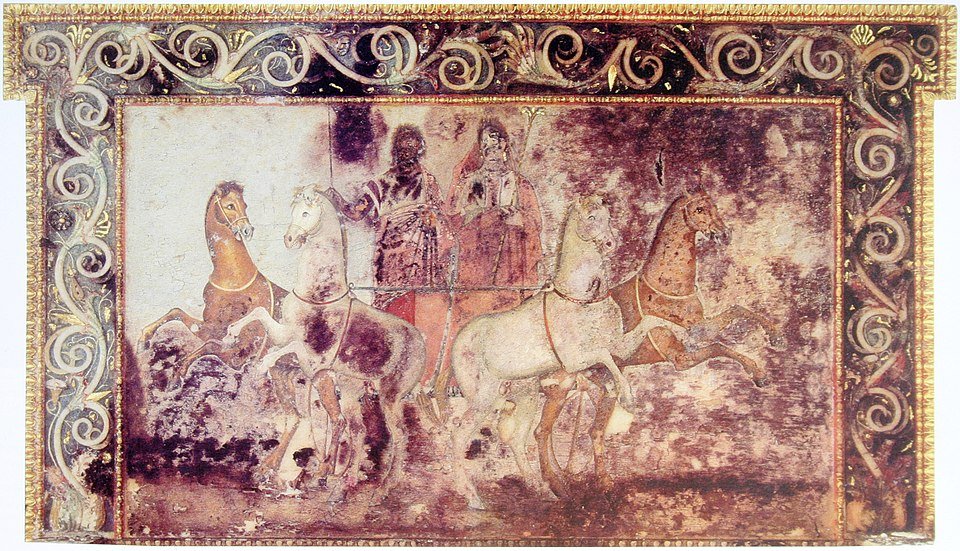
In a fresco from the tomb of Eurydice 1, Queen of Macedon, Persephone, Queen of the underworld, rides with Hades in his chariot.

Hear this unconventional and mysterious poem in Horace’s Latin and follow in English here.

Privacy Overview

This website uses cookies so that we can provide you with the best user experience possible. Cookie information is stored in your browser and performs functions such as recognising you when you return to our website and helping our team to understand which sections of the website you find most interesting and useful.