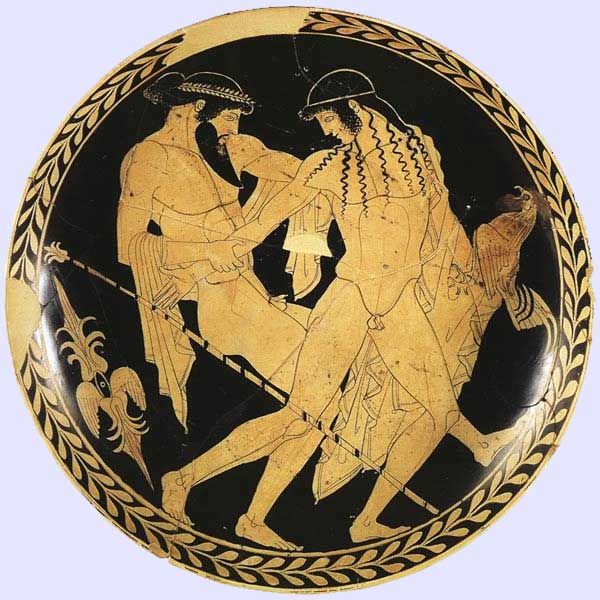
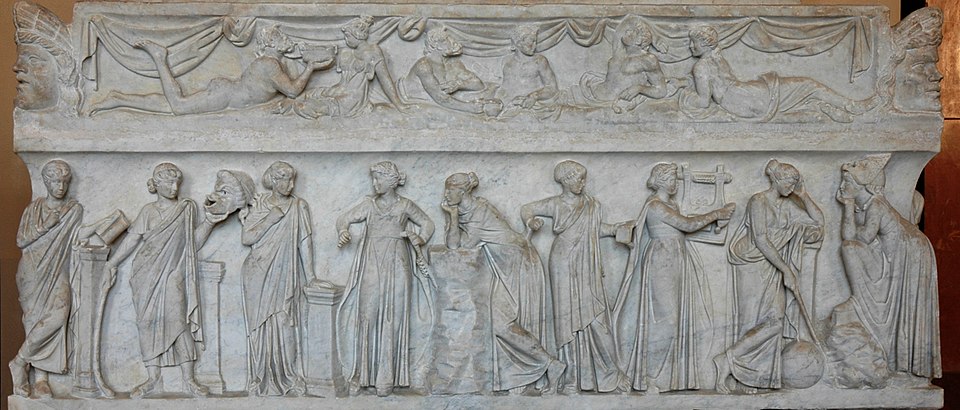
In this Ode, a dramatic monologue, Horace’s protagonist is keeping the peace at a vaguely Greek drinking-party that threatens to degenerate into a brawl. He distracts his companions by ribbing one of the company about a current love-affair – with a woman who, in the speaker’s opinion at least, is a spectacularly bad choice.

Hear Horace’s Latin and follow in English here.

There is perhaps some friendly exaggeration in the contrast that Horace draws between his own wine-drinking opportunities and those of his eminent friend and patron, Maecenas, but he offers the best he has, along with his affection and a flattering memory of a great occasion. Hear Horace’s Latin and follow in English here.

The illustration, from Herculaneum, is an advertisement for a wine-bar, showing the prices of the vintages on offer.

Horace has met a young woman, fiercely attractive and extremely unsettling. He is definitely interested, but appeals to the Gods of love and wine, Bacchus and Venus, to let him take matters more slowly and with a level head.

The illustration, from Pompeii, shows Venus and her lover, Mars.

Hear Horace’s Latin and follow in English here.

Horace usually avoids the great traditional themes and stories of epic poetry, but here he uses the new lyric style that he has developed from Greek predecessors to create an innovative poem about the Trojan war.

In a fresco from Pompeii, Helen boards a ship for Troy.

Hear Horace’s Latin and follow in English here.

Roman boxers fought with gloves designed to inflict the maximum damage on one another: the cestus,  heavy leather strapping studded with lead around knuckles and forearms. In the games that Aeneas holds in Book 5 of the Aeneid in memory of his father, Anchises, Entellus, a great athlete but now old and slow, takes on Dares, the fast and nimble young champion.

The illustration shows the aftermath of the bout in a Roman mosaic. Learn the significance of the bull, and hear Virgil’s Latin and follow in English, here.

Aeneas has spotted Helen of Troy, whose elopement with Paris caused the war and the destruction of Troy, lying low in the burning ruins. He has an angry impulse to kill her, but now his divine mother, Venus, intervenes to tell him that the city has fallen by the will of the Gods and that he must go home and save his family.

Hear Virgil’s Latin and follow in English here.

As Troy falls about her, and in fear for her life from both Greeks and Trojans, Helen takes refuge at the altars, where she is seen by Aeneas, newly come from the lost battle for King Priam’s palace.

Hear Virgil’s Latin and follow in English here.

Fighting his way to the heart of the palace, Pyrrhus, the son of Achilles, finds King Priam and his wife and daughters defenceless. Hear the denouement in Virgil’s Latin and follow in English here.

In Virgil’s Aeneid, the Greek invaders fight their way to the very threshold of Priam’s palace, as Aeneas joins the defenders in an attempt to stem the tide. The Greek assault is led by Pyrrhus, the son of Achilles.

Hear Virgil’s original Latin and follow in English here.

Privacy Overview

This website uses cookies so that we can provide you with the best user experience possible. Cookie information is stored in your browser and performs functions such as recognising you when you return to our website and helping our team to understand which sections of the website you find most interesting and useful.