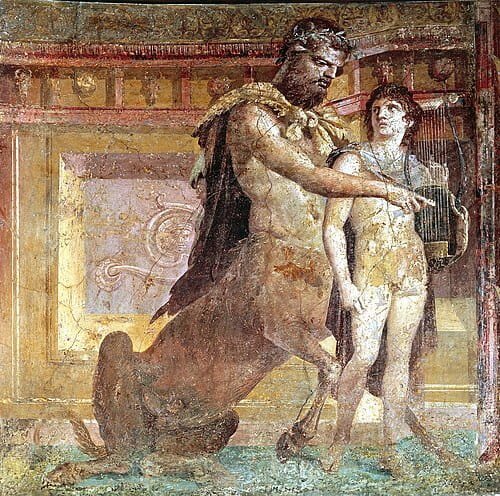
In a poem expressing Horace’s pride in being selected to write the anthem for a solemn state celebration occurring only once in any man’s lifetime, he expresses his gratitude to Apollo, the patron God of poets and poetry. Along the way, he gives a portrait of Achilles as a warrior who would not have stooped to the trickery of the Trojan horse and would have shown n o mercy to man, woman or child.
Horace’s chillingly unsympathetic description of Achilles’s cruelty is explained the legend that Augustus and the imperial family were of Trojan origins via Aeneas, son of the Trojan Anchises and the Goddess Venus. Why no mention of Achilles’s invulnerability except for his heel? Because that part of the myth appears first only in the first century CE, after Horace’s time and maybe 1,000 years after the stories which were to become the Iliad began to coalesce in Greek poetic culture.
In the illustration, a fresco from Herculaneum, in a more peaceful moment the Centaur Chiron teaches the young Achilles to play the lyre.
See Horace’s Latin and follow in English here.